
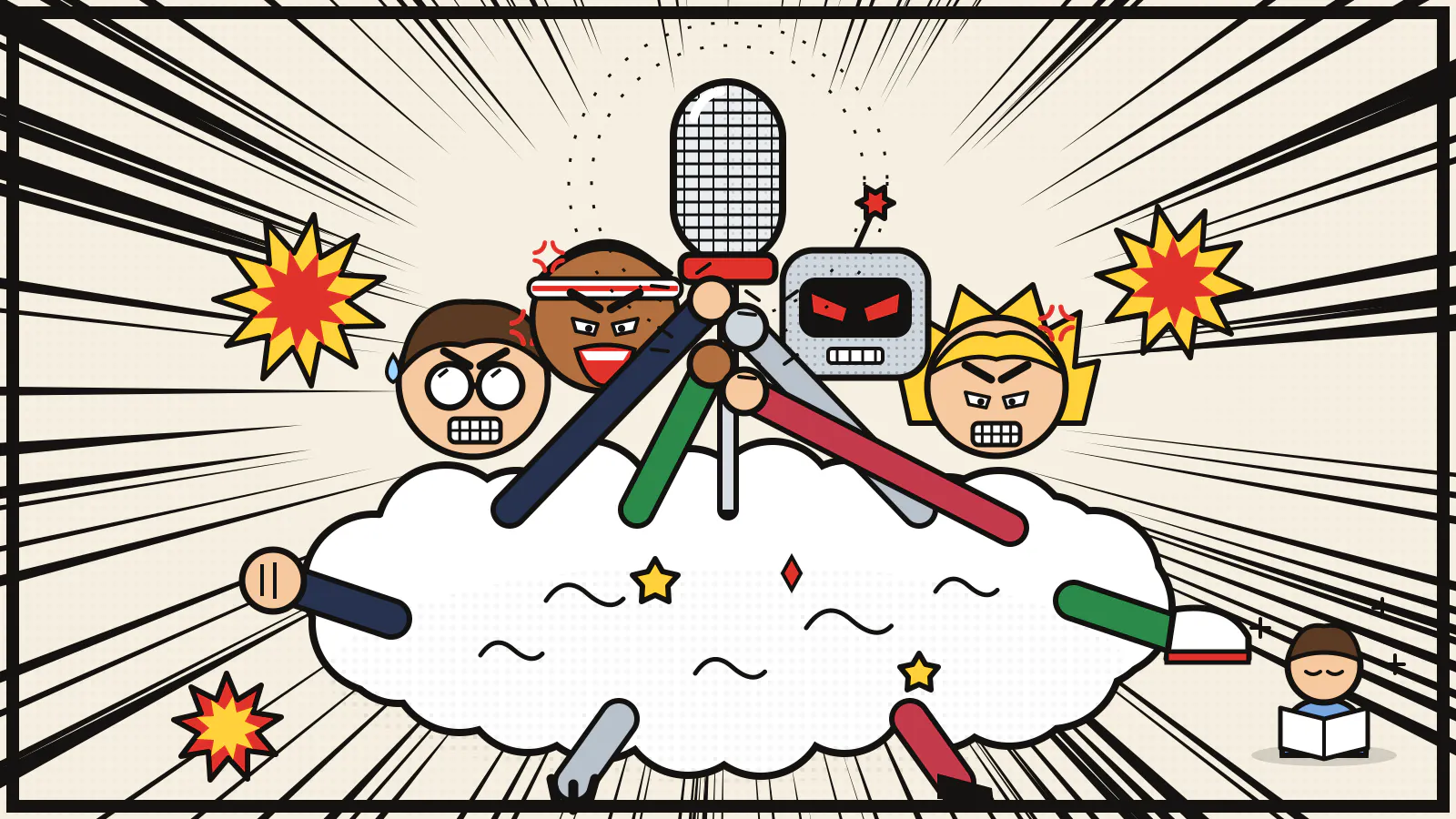
Andreessen Horowitz, Draymond Green, the White House and OpenAI now share a label. Each calls its own channel "new media." a16z built a New Media team. Green named his production company The New Media. The White House created a "new media seat" in the briefing room. OpenAI bought TBPN, the show that maps who counts as new media.
None of them owns the phrase. Each uses it to describe the same move: the subject of the coverage takes over the microphone. That is a real shift, and it deserves a name. But "new media" is a decades-old academic term, and the people now claiming it are mostly the ones journalists used to cover.
I've run HackerNoon since 2016. Its archive holds stories tagged "new media" dating to January 2016, and we moved off Medium onto our own platform in July 2019. So I have a stake in the question: who gets to define new media, and what should it mean now?
What "New Media" Meant Before It Became a Brand
Before it named a team or a podcast company, "new media" described technology. Wikipedia defines it as computational media that share material online and through computers. IEEE's topic page describes digital communication that is interactive, on-demand and addressable to individual users, as opposed to one-way print and broadcast.
The academic canon is Lev Manovich. In his introduction to The New Media Reader, he defined new media through eight propositions. One of them predicted the term's expiration: once most culture is distributed through computers, "new media" stops being new.
Scholars have argued about the word "new" for as long as they have used it. The textbook New Media: A Critical Introduction is built around the question of what is actually new about "new media". Media scholars have also criticized rigid distinctions based on oldness and novelty.
That old definition was about format: bits instead of ink. The 2020s definition is about power: who holds the microphone. The phrase is the same, but the meaning has changed.
A Short History of Who Has Claimed "New Media"
The phrase has changed owners roughly every decade. It started with educators, passed to a New York trade group and then to academic journals, was handed to users, and was picked up by political campaigns. Only recently did it reach athletes, venture firms and AI companies.
1959–1960 | Marshall McLuhan and the broadcasters. The National Association of Educational Broadcasters funded McLuhan to design a high school curriculum for "understanding new media". The resulting 1960 Report on Project in Understanding New Media complained that "media study has lagged behind all other fields in this century, even behind economics." The project ended early and faded from view. McLuhan spent four years rewriting it into Understanding Media (1964). The first owners of "new media" were educators, and their subject was television and radio.
Around 1990 | The press picks it up. Lev Manovich later dated the mainstream use precisely: "The term new media itself started to appear in press around 1990."
1994 | A venture capitalist founds the New York New Media Association. Investor Brian Horey started NYNMA, he said, so "we could stop flying to California every other week to do business." NYU Stern reported that membership grew to 7,000 people from 2,500 companies. A 2000 NYNMA survey counted roughly 8,500 companies and 250,000 jobs. Sociologist Michael Indergaard's book on the era is titled Silicon Alley: The Rise and Fall of a New Media District. In it, he argues that Wall Street veterans built the scene to redirect venture capital back to New York. The first commercial owner of "new media" was a VC network, three decades before a16z.
1996–1998 | Harvard builds a home for it. The first Harvard Conference on the Internet & Society in 1996 led to the Berkman Center at Harvard Law School, funded in 1997 and named in 1998. The Crimson reported the center was funded by a $5.4 million Berkman family gift. In 2005 it hosted the Blogging, Journalism, and Credibility Conference, which brought journalists, bloggers and media scholars together to study the emerging media environment.
April 1999 | Academia gets a journal. SAGE launched New Media & Society, with vol. 1, no. 1 dated April 1999. Its first issue included LSE professor Sonia Livingstone's "New media, new audiences?" Five years later, the anniversary issue opened with Leah Lievrouw's "What's Changed about New Media?" The journal ranked 13th of 96 communication journals in 2022.
2001 | MIT Press canonizes it. Manovich's The Language of New Media was billed as the first systematic and rigorous theory of new media. A reviewer called it the broadest media history since Marshall McLuhan's.
2004–2008 | Campaigns hire "New Media" directors. Joe Rospars was a writer and strategist in New Media for Howard Dean's 2004 campaign. He then became New Media Director for Barack Obama, overseeing email, video, texting, online ads and fundraising. In 2007 he described the job as working to "build relationships between Barack and his supporters." That was going direct, nearly two decades before a16z packaged it as a service.
December 2006 | Time names "You." Time's Person of the Year went to everyone creating user-generated content on blogs, YouTube and MySpace. Lev Grossman credited "you" for "working for nothing and beating the pros at their own game." Critics at the time called it the link bait of the year. In this version, new media meant the audience adding to the internet itself.
2019 | The name goes back to print. New Media Investment Group bought Gannett and gave up its own name (more below).
2022–2026 | The subjects take it. Draymond Green, Andreessen Horowitz, the White House and OpenAI's TBPN deal follow, each covered below.
The pattern runs in one direction. Each new owner sits closer to the subject of coverage and further from the reader. In 2006, Time handed the phrase to the audience. Twenty years later, the people being covered have taken it back.
Every Time Draymond Green Said It
Draymond Green has said "new media" so often that he turned it into a company. The documented record runs from 2022 to now:
- June 2022, NBA Finals. Green recorded his podcast from the press room after Game 6 and closed with a speech defining new media as respect, integrity and standing on your word. He warned that some athletes "start acting like the old media once they become the media."
- 2022, on the press. He framed new media against clickbait, asking reporters to "be very critical, but tell us the whole truth" and adding, "The new media, we protect guys."
- The Scott Van Pelt exchange. When ESPN's Van Pelt told him he was part of the media now, Green cut in: "New media." He insisted on the distinction even while promoting his own show.
- October 2022, TechCrunch Disrupt. Green told a tech audience that "me doing a podcast is very disruptive to the sports media industry" because the media can no longer create its own narrative.
- The trademark. He filed for "The New Media by Draymond Green", covering a podcast, clothing and athlete management.
- "It's a mindset." That is how he described his work to journalist James Brown, whose newsletter noted the show was produced by Colin Cowherd's network.
- April 2025. New media, he said, means "explaining the game of basketball, teaching the game of basketball" rather than outlandish statements made to start controversy.
- Late 2025, the company. Audacy struck a strategic partnership with Green and his production company, The New Media, to run sales, distribution and production. His podcast feed now credits episodes to "Audacy | The New Media".
The June 2022 Finals episode is the fullest version of his definition. Green set up in the TD Garden press room with Klay Thompson, Andre Iguodala and Gary Payton II. He had been criticized for podcasting between Finals games, and he promised to keep releasing episodes no matter the result. He went after ESPN for giving the Warriors a 20 percent chance to win and Fox Sports' Nick Wright for doubting Steph Curry. Then he laid out the rules: stand on your word, don't chase controversy, give credit when it's due, and teach the game. He named J.J. Redick and C.J. McCollum as fellow members.
The critics have used that rulebook against him. When Green went silent after punching teammate Jordan Poole, Awful Announcing pointed out that the movement's loudest advocate was providing no media at all. Defector later held him to his own 2022 standard after he repeated an unverified claim about Karl-Anthony Towns and then pivoted to promoting his show. In 2026, Awful Announcing questioned whether the model scales at all, arguing that athletes are too busy to sustain a good weekly show and that short clips on TikTok and Instagram already do the job.
The critics have kept score too. Awful Announcing noted that Green signed with Turner Sports and The Volume, two companies that would readily call themselves media. Draymond's definition shifts with the season, from loyalty to accuracy to teaching. What stays constant is the speaker: the person being covered now owns the microphone.
Every Time Andreessen Horowitz Said It
Andreessen Horowitz capitalized it, staffed it and put it in the main navigation. In a little over a year, "New Media" went from a team name to a product a16z sells founders during a pitch.
- Mid-2025, the team. a16z's New Media team launched around mid-2025; by June 2026 the firm was marking its first anniversary. It now sits in a16z's site navigation as its own section, a16z.com/new-media, beside the newsletters and podcast network.
- November 6, 2025, the manifesto. Erik Torenberg, Alex Danco, Henry Williams and Brent Liang published "What is New Media?" It describes a team that helps founders win attention online, an in-house video studio pitched as "the A24 of a16z," packaged launch campaigns and New Media staff who embed inside portfolio companies.
- The TBPN map. The same post bragged that a16z was the only VC firm on the TBPN New Media Map, appearing twice.
- January 2026, the fellowship. a16z opened an eight-week New Media Fellowship for operators, creators and storytellers, meant to place trained talent inside portfolio companies.
- June 18, 2026, the anniversary essay. "New Media, One Year In" defined the term as "go-direct as a service" for startups. It listed the owned channels behind it: an X account with a million followers, a newsletter with a quarter million subscribers and a podcast with a million monthly downloads.
- The podcast. Marc Andreessen and Ben Horowitz recorded "The New Rules of Media" with Torenberg and Gaby Goldberg.
The strategy goes back to the firm's founding myth. a16z says Marc Andreessen and Ben Horowitz modeled the firm on Michael Ovitz's Creative Artists Agency, which helped actors build franchises outside the studio gatekeepers. New Media extends that idea from founders' careers to founders' narratives. The same post describes the team as venture's Formula One pit crew: the general partners drive, and the media team changes the tires. It also commits to shipping the a16z podcast and newsletter five times a week.
The anniversary essay adds the sales mechanics. a16z pitches New Media to founders during what competitors call the Bear Hug, the reverse pitch where the firm sells itself to the startup. It cites launch results from World Labs, whose co-founder Fei-Fei Li credited the team with a launch video shot on a 3D LED stage. It also endorses a friend's definition from an essay titled "New Media is Insider Media", which opens with a line a16z quotes approvingly: "Insider Media is media for insiders, by insiders." a16z's only disagreement with that essay is about whether being in the in-group is positive-sum.
The most revealing lines are a16z's own admissions. The anniversary essay concedes that new media isn't actually new. It says the New Media-branded job postings are mostly classic marketing and comms work, and that the real change is in the packaging and branding.
That is the honest definition. For a16z, new media is a venture firm's PR and marketing function, rebuilt around owned channels and given a name that sounds like journalism. The essay all but says so: founders used to choose between being journalism and being PR, and New Media is pitched as the category in between.
Who Else Calls Itself "New Media"
Search for organizations that describe themselves as "new media" and a pattern appears. Very few are newsrooms. Most are government offices, investors, platforms or the subjects of coverage.
The White House. At her first briefing on January 28, 2025, Press Secretary Karoline Leavitt announced a "new media seat" and said the White House would adapt to the new media landscape. She invited independent journalists, podcasters and social media influencers to apply for credentials, through an application page at whitehouse.gov/newmedia. The seat later hosted Axios, Semafor, former sportscaster Sage Steele and influencer Tim Pool. Even sympathetic coverage noted that the "new" media isn't all new.
Leavitt justified the seat with Gallup polling showing trust in mass media at a record low. The first questions went to Axios's Mike Allen and Breitbart's Matt Boyle. Later, she held a separate briefing for new media outlets only, which she opened by calling it the White House's first influencer briefing. Rutgers media historian David Greenberg put the change in context, noting that "the nature of the press in the White House press room has been diversifying" for some time.
New Media Investment Group. The most ironic claimant was a newspaper roll-up. New Media Investment Group, parent of GateHouse Media, agreed in August 2019 to acquire Gannett for cash and stock. USA Today valued the deal at about $1.38 billion. Then the company called "New Media" rebranded itself as Gannett, the older name, because it was the more recognized brand.
TBPN and OpenAI. TBPN, the daily live tech show hosted by John Coogan and Jordi Hays, publishes the New Media Map that a16z boasted about. In April 2026, OpenAI acquired TBPN and placed it in its Strategy organization. OpenAI's announcement says the show reports to Chris Lehane. OpenAI promised editorial independence, but the arbiter of who counts as new media now belongs to one of the companies it covers.
TBPN is small for something this influential. Coogan and Hays launched it in October 2024, and by the sale it had 11 employees, about 70,000 viewers per episode and sponsors including Ramp, Plaid, Google's Gemini and the New York Stock Exchange. Tech CEOs including Mark Zuckerberg, Satya Nadella and Marc Benioff used the show to speak more freely than they would with traditional press. Sam Altman posted that "TBPN is my favourite tech show." The New York Times had recently called it Silicon Valley's newest obsession. A daily show known as the place where CEOs talk candidly now belongs to one of those CEOs' companies.
Draymond Green and a16z, covered above, complete the list: an NBA forward who trademarked the phrase and a venture firm that staffed it.
Only the White House seat explicitly admits journalists. The rest belong to someone being covered: an athlete, an investor, an AI lab or a newspaper chain that wanted a modern-sounding parent. That is what "new media" means in practice today: the subject owns the channel.
What Google Thinks "New Media" Means, and Why
Search the bare phrase "new media" and neither a16z nor Draymond Green shows up near the top. The results are still the textbook version of the term.
A web search run for this story returned, in order of prominence: Wikipedia's "New media" article, IEEE's topic page, listings for the textbook New Media: A Critical Introduction, an NYU Stern research framework on new media technologies, and generic explainers like FourWeekMBA's. Near the bottom sat templated "examples of new media" pages built to capture the query.
Three forces explain this.
1. Query intent. A two-word generic phrase reads as a definition request. Search engines answer definition requests with reference sources, not brands.
2. Accumulated authority. Wikipedia, IEEE, publishers and universities have linked to the academic meaning for decades. a16z's "What is New Media?" is less than a year old. Even its title is a definitional query, and it still sits behind the encyclopedia.
3. Branded claims rank for branded queries. a16z's New Media page targets "a16z new media." Green's Audacy deal coverage attaches "The New Media" to his name. The White House wins "new media seat." Each claimant controls a modifier, not the term itself.
This matters beyond SEO. The pages search engines trust are also the pages AI models learn from and cite. Ask an answer engine what new media is, and it will likely give you Manovich, not Marc Andreessen. That is the quiet answer to who owns the phrase: the reference corpus does, and the reference corpus still says it means digital, interactive media.
So Who Owns "New Media"?
Nobody owns the phrase. Green's filing covers a branded mark, "The New Media by Draymond Green," not the two words anyone can use. a16z owns a team name and a URL. The White House owns a chair. OpenAI owns the show that draws the map.
The definition is up for grabs, though, and the current claimants agree on one version: new media is the subject of coverage going direct. a16z's anniversary essay calls it "go-direct as a service". Green calls it explaining the game instead of chasing controversy. That is a legitimate strategy. It is also PR with better production values.
There is a second definition worth fighting for. It puts the reader at the center, not the speaker. In this version, new media is wherever people, and now AI models, go to learn something. It is built by contributors who know the subject, and it is distributed on channels the publisher controls. Its test is whether the reader learned something true, not whether the founder won the day online.
HackerNoon has been working this way since before "new media" was a venture-firm department. We replaced Medium's CMS with our own publishing platform in 2019, which is what owning your distribution meant before a16z called it table stakes. A recent HackerNoon story argued the real divide is not old media versus new media but business versus culture. I agree with that framing.
Manovich predicted the term would stop being new once culture moved onto computers. It did. The fight now is not over the phrase. It is over whether "new media" describes the people talking or the people learning. For now, the people talking are winning.